
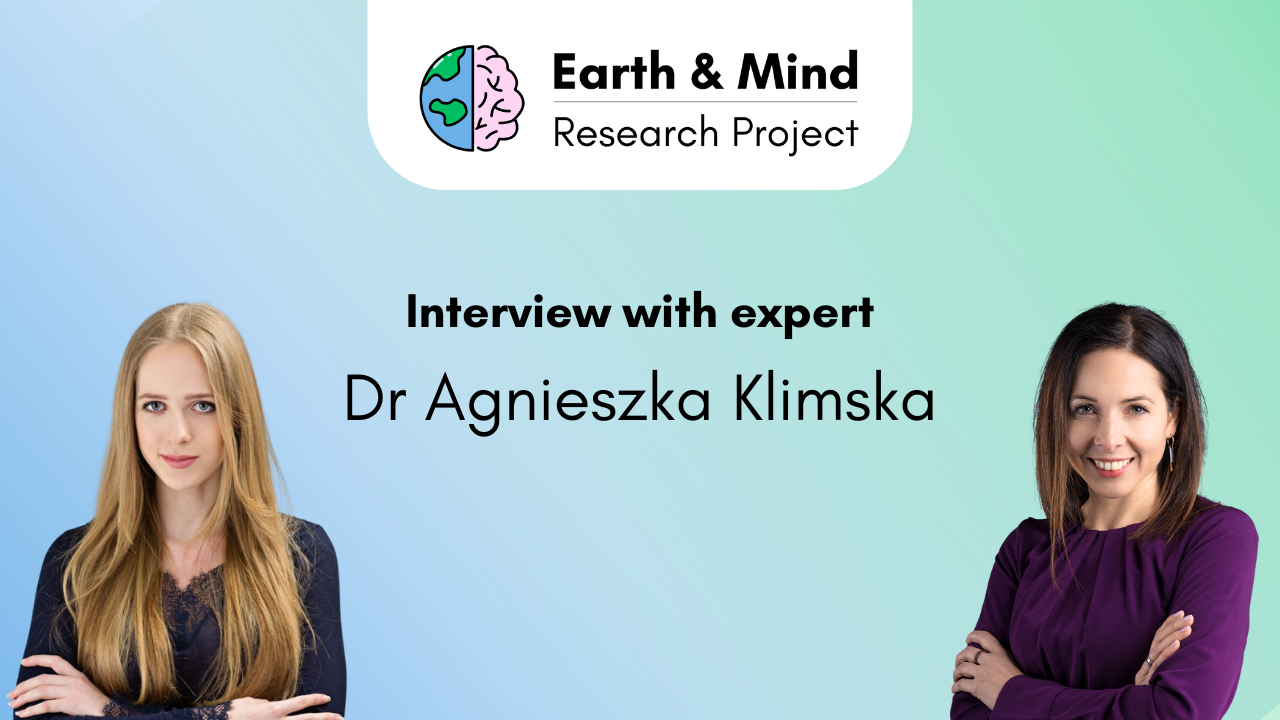
Continuing my journey in the Earth and Mind Research Project, I had the privilege of interviewing Dr. Agnieszka Klimska, research and didactic employee at Cardinal Stefan Wyszynski University in Warsaw. Dr Klimska is an Assistant Professor at the Institute of Pedagogy and the Institute of Philosophy, she deals with issues of sustainable development and climate change primarily in educational and ethical aspects. Dr Klimska is also an author of scientific publications, scenarios and lesson plans in the field of sustainable development, environmental education, substantive expert of the youth project “Acclimatized”, member of the Regional Centre of Expertise on Education for Sustainable Development – RCE Warsaw Metropolitan and contractor of projects in the field of environmental education and protection of the socio-natural environment.
Dr Klimska agreed to discuss with me such important topics as various attitudes towards climate change in Poland, generational differences, or complex emotional states related to apparent environmental changes. My interviewee pointed out several crucial insights, such as the fact that the main reason for passive attitudes towards the discussed issue is a reluctance to give up certain conveniences as well as a lack of trust in the effectiveness of taken actions.
The entirety of the conversation provided many more valuable thoughts, that will greatly improve my research as well as my understanding of the current situation. I would like to express my gratitude to Dr Agnieszka Klimska for her time and productive discussion.
I strongly encourage you to read the full version of the interview available below.
I also invite you to take a closer look at my previous, just as interesting and valuable interviews with Dr Caroline Hickman, Anouchka Grose, Ben Hart and Giovanni Telesca.
Konstancja Cegłowska: What attitudes towards climate change do you observe in Poland? Is there a noticeable difference between social groups? If so, what kind? What is its cause?
Dr Agnieszka Klimska: By virtue of my scientific interests and my work, the issue of climate change has been close to me for more than a dozen years. During this time, I have been able to observe how public attitudes towards climate change are being formed.
In my opinion, by far the most committed to climate issues are young people. I am thinking here primarily of people of high school and college age. This is probably due to the fact that it is partly on them that the burden of fighting for the future of the world has been thrown.
Positive attitudes towards climate change, expressed in concrete, informed choices are discernible among communities living in larger cities. This is due to the availability of environmentally friendly infrastructure, greater efforts to promote good practices or create awareness of climate change among citizens, but also to engage in campaigns that are “at their fingertips.” Residents of large cities are much more taken care of in this regard than the community living in non-urban areas.
This is confirmed by studies or reports that point out that while people recognize climate change, they do not look at the problem locally.
How has this issue changed over the years?
In my opinion, those in the Baby Boomers generation, although they recognize climate change and even the effects, do not think about the causes, much less link them to their own activities. The case is different for Generation X and Y. Their awareness of climate change is greater although it does not necessarily translate into attitudes. They are more likely to declare that they are ready to counter climate change, but this is not as often reflected in their attitudes. From my observations, Generation Z is the most committed to climate change, which is due to the fact that they are growing up and forming their views in a world of constant access to information about threats, global issues, etc. The forms of messages that reach them are not only much richer, but also more clearly appealing and driving them to action. However, the motivation to take these actions sometimes varies. In addition, this is a generation that had the chance in the process of school education to learn about the anthropogenic impact of humans on the environment.
Positive attitudes towards climate change are also associated with a certain fashion for living “eco” or in accordance with the postulates of sustainable consumption. This is strongly influenced by social media, especially the activity of influencers who promote pro-environmental attitudes and habits.
What attitudes to climate change prevail in Poland? What are their causes?
In my opinion, passive attitudes toward climate change still prevail. Although awareness of the change itself and the risks is growing, it is not translating into action or choices. Where do such attitudes come from? First of all, from convenience. We tend to be able to give up things that do not involve huge sacrifice or significant restrictions. On the other hand, from the side of the young there are voices that they do not want to take responsibility for what others, older ones, have done. Why should they, because of the negligence of earlier generations, now take up the fight against climate change? Despite a sizable group of young people committed to climate action, there is also a segment of society that accepts this narrative. Still others are paralyzed by fear and pessimism. They do not believe that anything can still be done and are passive observers of negative changes.
What can be done to motivate passive people?
First of all, it is necessary to find out for what reason they are not taking action to protect the climate. If they are climate denialists one can try to convince them, based on reliable scientific sources, that climate change is a fact. However, there are opinions that since there are far fewer climate denialists, the focus should not be on changing their beliefs and positions, but should instead focus on working with people who are aware of and confident in the dangers of climate change.
Probably a sizable group of people who are aware of the dangers of climate change are not taking any action to protect it. In my opinion, it is worth showing them how these changes negatively affect individual humans – specifically, themselves. For it turns out that, unfortunately, some people are not able to give up their own comforts, to go beyond their comfort zone. Sometimes they are unaware that small changes can bring considerable benefits. Some also think that their “positive change” – some specific good practice – is a “drop in the ocean” in the face of global needs. Besides, if others don’t sacrifice, why should he or she.
However, it is worthwhile with various activities to teach responsibility for future generations and implement positive practices at every stage of a person’s life. Various forms can be used for this. First, teach from an early age in homes, kindergartens, schools. Secondly, create as many campaigns and projects as possible, during which solutions for climate protection are “smuggled in”. It is worth showing the involvement of well-known people, authorities in various fields, who can also promote certain attitudes.
What can be done to support active people?
Above all, it is worth appreciating even the smallest actions, promoting them, rewarding them, showing their importance. Recognizing someone’s involvement, emphasizing its legitimacy and showing interest and support will work to drive and motivate.
What emotions about climate change can we observe in our country?
I perceive extreme emotions in this regard. Here comes the problem of combining the need for climate protection with political action. Where there is politics, there are strong emotions both positive and negative. If we combine climate action with politics or tie it to other issues on the principle of getting “two birds with one stone,” we may not move on. Climate activists are sometimes viewed negatively if at the same time, for example, they promote other content or attitudes in their marches, such as opposition to specific politicians or the needs of LGBT people. Each of these issues people have the right to consider important, but each should be pursued separately. Associating them with each other can cause negative emotions.
What complex emotional states / mental models related to climate change do you see in our country?
Here I can refer to what I mentioned in my answer to question 3. I don’t know if these are complex emotional states (I’m not a psychologist, so I don’t want to elaborate too much on this, since I don’t have enough knowledge on the subject), but I can see that these are different emotional states, often extreme.
I observe them, if only in my work with students. Many factors influence their attitudes or emotions. If we discuss the consequences and predictions of climate change, states of resignation, doubt and emotions such as disappointment or sadness are noticeable. Other times, when I show the results of various climate protection activities, passion and commitment, not only of some organization, foundation or institution, but of ordinary people, then the emotions in the same people are different. Optimism and enthusiasm appear. That’s why I often emphasize that a lot depends on the narrative and the way to stimulate action. If everything is based on scaremongering and alarming how little time we have left, this will not necessarily translate into action, changes in attitudes, etc.
Referring to mental models, it’s worth mentioning, for example, the strong belief that is in the minds of many of us that we can’t do anything ourselves. After all, others don’t do anything! So what if I’m going to reduce consumption if others don’t want to change it! What about big businesses? After all, there is a lack of control, and if there is, financial penalties are not a burden on these companies! Etc.
Such images and such beliefs will limit our activities, willingness to change already at the idea stage.
Of course, such a mental model is also a conviction about the natural process of climate change, which is completely unaffected by human functioning. This is because some people still debate and even question the assessments of the scientific evidence on climate change by the Intergovernmental Panel on Climate Change. We also continue to encounter the opinions of climate deniers who deny the phenomenon of global warming.
How do you think people will react when the most pessimistic predictions come true?
I think they will be gripped by even more fear and an even greater sense of powerlessness in the face of what may yet come.
Unfortunately, we don’t learn from our mistakes, and in my opinion we will be thinking about climate migration rather than countering change.
What happens to people’s mental health in the context of climate change?
It depends from which side you look at it. Some people still have too little awareness of climate change and their mental health definitely improves as the temperature rises. I’m joking a bit here. But I want to emphasize that there are people who at the thought that there will be no cold winters, that the summer will be warmer feel better mentally.
However, referring to scientific data, the level of anxiety about the future on Earth is increasing, depressive states related to fears about the future are appearing. For example, some people experience anxiety states due to the disruption of the seasons, while others choose not to have offspring due to concerns about climate change.
Who is most vulnerable to mental health deterioration in the context of climate change?
Most vulnerable are young people, who already, research shows, are the least resilient to current changes in their home, school or work environments. This group sees climate change as one of the key threats to civilization. It used to be that climate change was not perceived as a major threat. Scientific units that study the phenomenon recognize that for the past two years, concerns about life and health have been closely linked to climate change. They appear right behind wars and epidemics. Interesting research on the subject is being conducted by Prof. Izabela Kapsa and Dr. Wojciech Trempała of Kazimierz Wielki University in Bydgoszcz, among others.
Are there cases in which a person reaches out for psychological support because of climate change?
Absolutely. This is a result of climate stress and even climate depression. Research by psychologists is emerging in this area, which shows the scale on which we are already dealing with mental difficulties resulting from climate change, the effects experienced, and especially anxiety about the future. I encourage you to read the research and scientific publications of Dr. Magdalena Budziszewska of Warsaw University and Dr. Weronika Kalwak of Jagiellonian University.
We should also not forget about the groups of people who report to a psychologist or psychiatrist because they cannot cope with the idea that they will have to sacrifice something, give up something, due to climate change. I’m not just talking about giving up some comforts or, for example, the fear that airplane flights will be restricted. I mean, for example, miners who fear for their future, their professional fate, whether they will be able to support their families, etc.
Do you observe a special sensitivity of a particular social group?
I am not competent enough to answer this question. It seems to me that younger people are more sensitive, because they realize that with the effects of climate change, they, not we (the elderly), will be the ones left behind.
What factors matter?
What matters are individual factors in particular, i.e. how each of us reacts to specific data from climate change reports, to what extent we fear for our lives and those close to us (in the context of climate change), how we react to stressful situations in general, etc.
What remedial and supportive strategies do we have at our disposal in the context of mental health, since climate change and environmental degradation are constantly accompanying us?
This is now a task for psychologists, who in this regard should join forces with climate change and environmental scientists, as well as with educators and ethicists.
How can we learn to function with the constant changes taking place in our environment in mind?
You can’t learn it, you can get used to it and try to react properly to these changes. Nowadays, there are some changes in every area of life. In fact, hardly anything is stable nowadays. I think that millenials (generation Y) will neither have to learn nor get used to any changes. This is already written into their lives to some extent. In the face of the changes taking place, they will reassert themselves that they can basically count on themselves first and foremost. The traditional model of family, friendship, authority figures are disappearing. Even universal values are becoming less and less significant. Where is stability, balance supposed to come from? That’s why I emphasize it so often, that the young are more likely to be lonely, lost and stressed because of the changes taking place. The consequences of changes, including those taking place in the environment, will affect them more.
How relevant is psychology in the context of climate change, what is its role?
Psychology is important in the sense that it can give tools to counteract and combat climate stress or depression. To some, it seems unbelievable that someone is struggling with anxiety because of the climate. A bit abstract, but at the same time real and unfortunately increasingly common. It is therefore important to build mental resilience in this aspect as well. This is a challenge for psychologists, and this is where psychology is beginning to develop in Poland.
To what extent are psychological factors taken into account in the discussion of climate change in our country, or to a sufficient degree?
In my opinion, these issues are completely ignored. There is no talk at all about fear, negative emotions, climate depression. There are messages like The young are worried about the future. However, they are completely unrelated to the actual conditions. After all, fear does not only mean perceiving that something is wrong. Fear can involve permanent stress, anxiety, resignation, etc.
Here again, awareness-raising activities are needed, for few people realize that climate change can bring, as much as COVID-19, stress, fear for their own lives and those of their loved ones.
Does Poland differ significantly from other countries in the aspects discussed above?
It is difficult for me to assess this clearly, because in other countries, despite having a more firm or developed climate policy, actions are allowed that contradict the assumptions of the policy. Still, money rules, and sometimes the interests of “others” turn out to be more important than the welfare of current and future generations.
Thank you a lot for the conversation!
Thank you too.